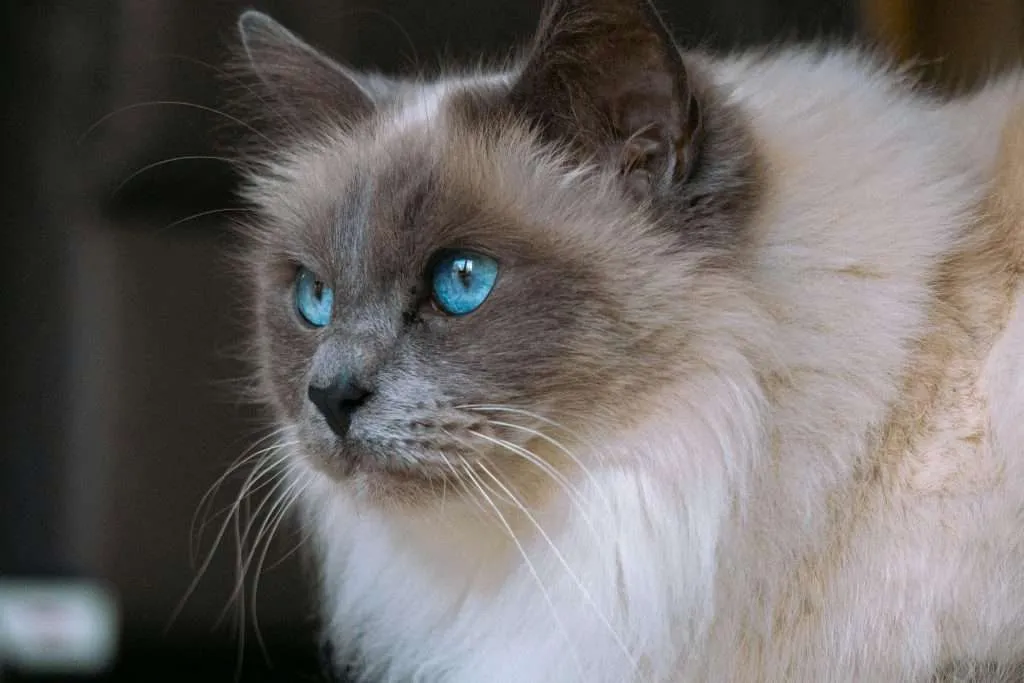
Table of Contents
- Understanding Ragdoll Genetics
- Ragdoll Cat Colors
- Point Patterns
- Special Color Variations
- Frequently Asked Questions
- Expert Tips from a Breeder
As a Ragdoll breeder who has dedicated several years to these wonderful cats, I’ve had the privilege of watching dozens of Ragdoll kittens develop their stunning coat colors and patterns. Ragdolls are known for their striking color point system, plush coats, and variety of patterns that make each cat uniquely beautiful. In this comprehensive guide, we’ll explore everything you need to know about Ragdoll cat colors and patterns, from genetics to show standards.
Are you a prospective Ragdoll cat owner researching your future companion or a current owner curious about your cat’s coloring? Keep reading to learn more about Ragdoll genetics and color expressions.
Understanding Ragdoll Genetics
The magic of Ragdoll cat coloring begins with genetics, specifically the Himalayan gene that creates their distinctive pointed pattern. This temperature-sensitive enzyme affects melanin production, resulting in darker coloring on the cooler parts of the body (points) and lighter coloring on warmer areas (body).
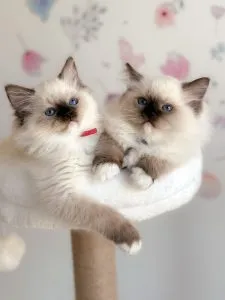
All Ragdoll kittens are born completely white, which often surprises first-time breeders. The point coloring begins developing within the first few weeks of life, with full color development taking up to two years. As a breeder, I’ve observed that color development follows a predictable pattern:
- Week 1-2: Pure white
- Weeks 3-4: Slight darkening at points
- Months 2-4: Distinct point coloring emerges
- Years 1-2: Color continues to deepen and mature
Temperature plays an important role in color expression. During colder months, you may notice your Ragdoll’s coat becoming slightly darker overall, while warmer temperatures can lead to lighter coloring.
Ragdoll Cat Colors
Seal Point
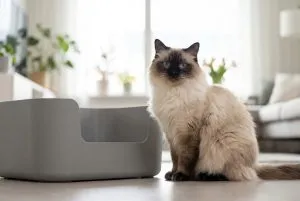
The most traditional and popular Ragdoll color, seal points display:
- Deep, warm brown points (almost black)
- Cream to fawn body color
- Dark brown nose leather and paw pads
- Blue eyes with dark rims
Breeder’s Note: Seal points typically show their point coloring earliest among all colors, often visible by 3 weeks of age.
Blue Point
A dilution of the seal point gene, resulting in:
- Blue-gray points
- Bluish-white body
- Slate gray nose leather and paw pads
- Clear blue eyes
Breeder’s Note: Blue points often have a softer, more ethereal appearance that many buyers specifically request.
Chocolate Point
A beautiful brown variation showing:
- Milk-chocolate colored points
- Ivory body
- Cinnamon-pink nose leather and paw pads
- Bright blue eyes
Breeder’s Note: Chocolate points can be challenging to identify in kittens, as their points develop more slowly than seal points.
Lilac Point
The dilute version of chocolate, featuring:
- Frosty gray points with pink tones
- White body with minimal shading
- Pink-tinted nose leather and paw pads
- Bright blue eyes
Breeder’s Note: Lilac is one of the most sought-after colors in our cattery, though also one of the rarest.
Red Point
A striking variation displaying:
- Reddish-orange points
- Creamy white body
- Pink nose leather and paw pads
- Blue eyes
Breeder’s Note: Red points can show “ghost marking” even as kittens, which can help predict adult pattern intensity.
Cream Point
The dilute version of red, showing:
- Soft cream points
- White body
- Pink nose leather and paw pads
- Blue eyes
Point Patterns
Colorpoint
The classic Siamese-style pattern featuring:
- Solid colored points (face, ears, legs, tail)
- Light-colored body
- No white markings
- Clear distinction between point and body color
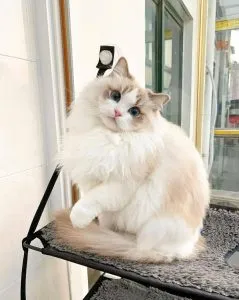
Mitted
A popular variation including:
- Colored points like colorpoint
- White “mittens” on front paws
- White “boots” on back legs
- White chin and chest
- Optional white blaze on face
Bi-Color
Distinguished by:
- Inverted “V” on face
- White chest and stomach
- White legs (varying amounts)
- Color on back and tail
- Varying amounts of white on face
Van Pattern
The most white-heavy pattern showing:
- Color primarily on ears, tail, and face
- Mostly white body
- Minimal body markings
- May have scattered color patches
Special Color Variations
Lynx Points
Also known as tabby points, featuring:
- Distinct striping in point areas
- “M” marking on forehead
- Lighter and darker bands on legs
- Striped tail
- Light colored “thumb prints” in ears
Breeder’s Note: Lynx patterns are most visible in lighter colors like blue and lilac.
Tortie Points
A stunning combination showing:
- Mottled points with patches of red/cream
- Available in all base colors
- Unique patterns to each cat
- Only occurs in females
Mixed Variations
Complex combinations including:
- Tortie-lynx (stripes with tortie coloring)
- Cream-lynx
- Blue-cream
- Lilac-cream
Frequently Asked Questions
Why is my Ragdoll cat’s color changing?
Color changes are normal and can occur due to:
- Age (continuing development until 2 years)
- Seasonal temperature changes
- Health factors
- Hormonal changes
How can I predict my Ragdoll kitten’s adult color?
Look at:
- Point color at 8 weeks
- Parent colors
- Early pattern development
- Paw pad color
What Ragdoll cat colors are accepted in show standards?
All traditional colors and patterns are accepted by major cat associations, but standards vary. Always check with your specific registry for current requirements.
Expert Tips from a Breeder
After years of breeding Ragdoll kittens, here are my top insights:
- Photographing Colors
- Natural light shows true colors best
- Morning or late afternoon lighting is optimal
- Avoid flash photography
- Use a neutral background
- Color Development
- Be patient with color development
- Document changes with photos
- Expect seasonal variations
- Colors typically deepen with age
- Common Misconceptions
- Not all Ragdoll kittens darken significantly with age
- Pattern expression varies greatly
- White spotting can be unpredictable
- Color intensity varies by individual
Ready to Find Your Perfect Ragdoll Kitten?
About Our Cattery: Posh Raggies
At Posh Raggies, we raise beautiful Ragdoll kittens of all colors and patterns in our Northern New Jersey home, just 20 minutes from NYC. As a TICA-registered breeder, we focus on both gorgeous coats and friendly personalities. Our kittens come from champion lines and grow up with lots of love and attention from our family.
Whether you’re looking for a classic seal point or a rare lilac pattern, we can help you find your perfect match. If you’re interested in adding a Ragdoll kitten to your home, we’d love to hear from you! You can submit an application or reach out to us directly to learn more about our available kittens and upcoming litters.